
Mark Carney’s Davos speech has attracted a lot of commentary, much of it simplistic. Some have treated it as a dramatic break with the past, or as an emotional response to one presidency, one election cycle, or one set of tariff threats.
But the more interesting point isn’t that Carney is suddenly “anti-American,” or that Canada has woken up one morning to discover power politics exists. The point is that Carney is naming—plainly, in a public forum, in the voice of a cautious establishment figure—something that has been true for a long time: in a deeply integrated world, the infrastructure of cooperation can also become the infrastructure of coercion.
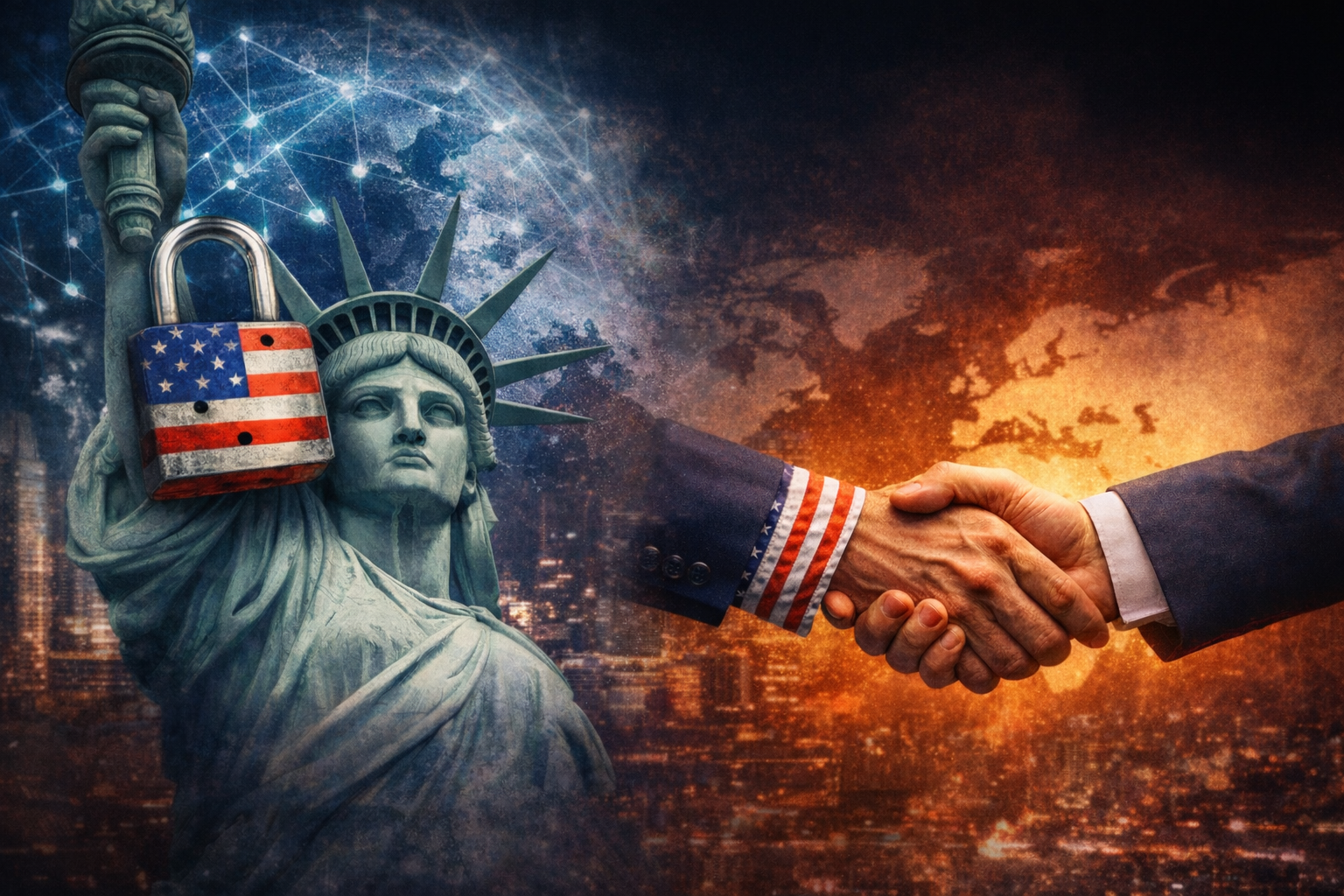
That idea has a name in international relations: weaponized interdependence. The concept is straightforward. Globalization doesn’t just create efficiencies. It also creates chokepoints—narrow channels through which money, information, trade, and security arrangements flow. Whoever controls those chokepoints can exert power, sometimes without firing a shot.
And here is the part that gets missed in much of the commentary: this didn’t begin with Donald Trump.
The American-Led Order Always Had Leverage Built Into It
Since the Second World War, the United States has played a central role in building and maintaining the “plumbing” of global life: finance, trade rules, payment systems, shipping lanes, security alliances, and (later) the technological platforms that sit underneath modern commerce and communication.
That system provided real public goods. It also benefited the United States enormously. And it always came with an implicit reality: if the U.S. was the architect and guarantor, it would also be the ultimate gatekeeper.
Sometimes that leverage was used quietly. Sometimes it was used overtly. Sometimes the ends were broadly supported (counterterrorism, non-proliferation, sanctions against regimes viewed as rogue). But the underlying mechanism was the same: participation in the system depended, at least indirectly, on U.S. permission.
The clearest example is financial. Global trade runs on dollars. Banks that want to be serious international players need access to the U.S. dollar clearing system. That requirement gives the United States extraordinary reach. It can make institutions radioactive by restricting access, and because most of the world can’t afford to be cut off, enforcement cascades outward.
That reality did not suddenly appear in 2016 or 2025. It is a structural feature of American predominance.
What Changed: The Shift From Quiet Leverage to Performative Coercion
So why does the concept feel newly urgent?
Because how leverage is used changes what it does.
For decades, the system depended on a bargain—often unspoken—between American power and allied confidence. The U.S. could use the chokepoints, but it generally wrapped that power in an institutional story: rules, stability, predictability, restraint, and a general commitment (however imperfect) to a values-based order.
That story was never fully true. But it was “true enough” for many countries to accept deeper integration, because the benefits were immense and the risks seemed manageable.
Trump changes the risk calculation—not because he invented coercion, but because he is inclined to use it openly, personally, and transactionally.
When the implicit message becomes “pay up” or “bend the knee,” the relationship stops feeling like an alliance and starts feeling like a protection racket. It becomes difficult for partners to treat the system as neutral infrastructure. They begin to see it as a tool that might be turned on them at any moment, for reasons that are not legal, strategic, or moral—but personal, political, or impulsive.
That is the rupture Carney is trying to describe. Not that the United States has leverage. It always did. The rupture is that the pretense of restraint is eroding, and with it, the willingness of others to remain dependent.
The Real Consequence: Hedging Becomes Rational, Even If It’s Expensive
Once interdependence feels like vulnerability, the rational response is to hedge.
That can mean building redundancies—alternative supply chains, alternative payment routes, domestic industrial capacity, or new trade blocs. It can mean “friend-shoring.” It can mean hardening systems so they can withstand pressure. It can even mean uncomfortable geopolitical balancing: if the U.S. is unpredictable, some will look for leverage elsewhere, even in places they don’t trust.
None of those strategies is free. In fact, many are costly. Global integration really did raise living standards and create growth. Pulling back from it means sacrificing some efficiency for resilience.
But once the risk becomes existential, countries accept the cost. They “buy insurance.” They pay more to be less exposed. And the more overtly the leverage is used, the more this re-engineering accelerates.
Why This Matters Beyond Politics
It’s tempting to treat this as theatre—speeches, slogans, and personalities.
But what’s at stake is something more technical and more durable: the future design of the world’s infrastructure.
The question is whether the global system continues to be built around a small number of chokepoints—financial, technological, and security—or whether it becomes more fragmented, redundant, and regionally anchored. A world with fewer chokepoints may be less efficient, but it may also be less susceptible to coercion.
In other words, the issue isn’t just whether Trump is rude, or whether Carney is “overreacting.” The issue is whether the world has reached the point where dependence on any single gatekeeper is no longer seen as a tolerable risk.
Carney’s speech matters because it says the quiet part out loud. Not that power exists. Not that America has leverage. But that the bargain underpinning deep integration—confidence in restraint—can no longer be assumed.
And once that confidence is gone, the system doesn’t collapse overnight. But it does begin to rewire.