
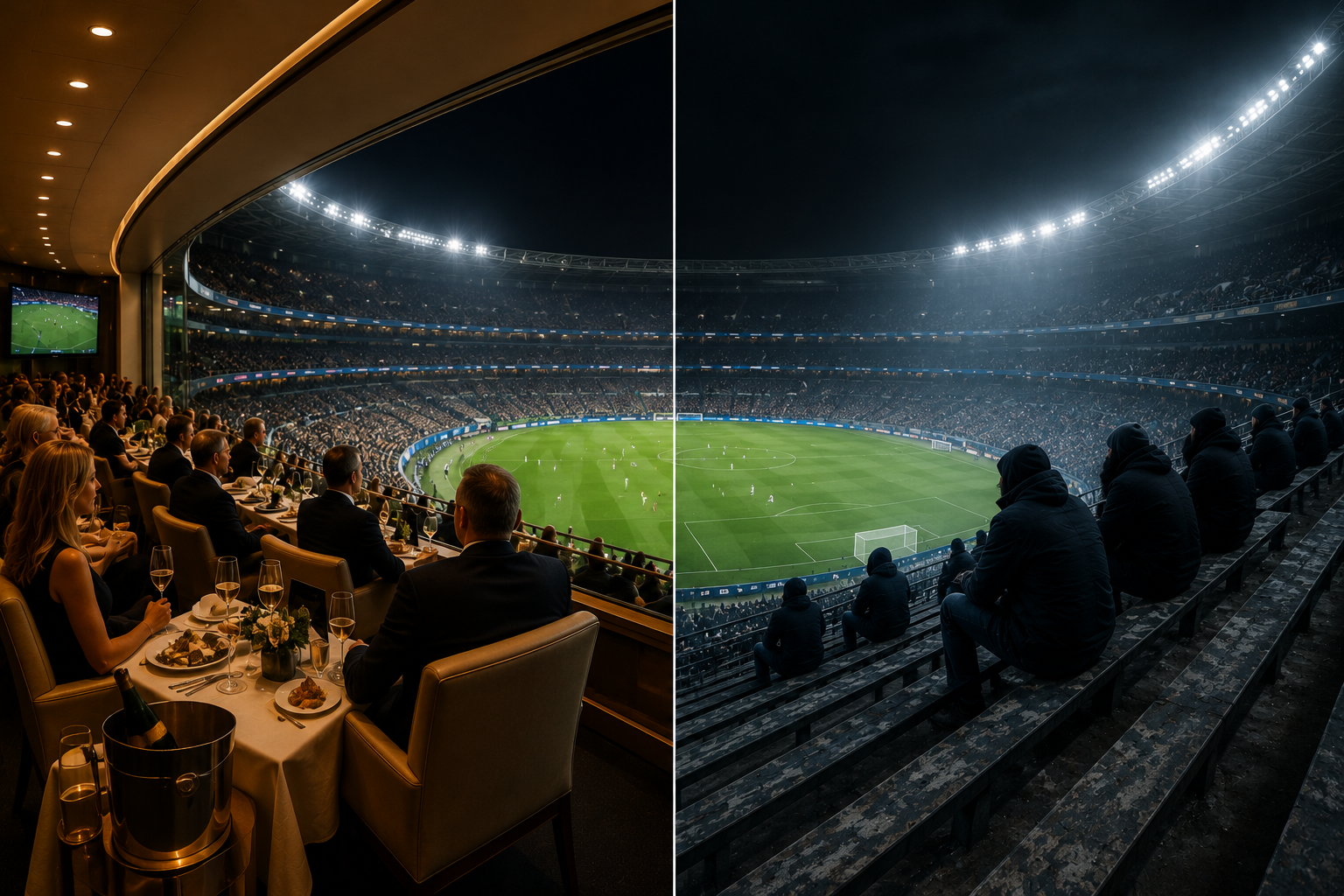
I recently read an article about the economics of the 2026 FIFA World Cup. The numbers were staggering. Dynamic pricing. Thousand-dollar tickets for ordinary games. Five-figure prices for the final. Train fares costing more than many people once paid to attend an entire sporting event. As I read, I found myself wondering whether times have really changed. History suggests that perhaps they have not.
For centuries, society has been divided between those who had wealth and those who did not. In the great theatres of Europe, the wealthy occupied private boxes. They sat comfortably, often dining and socializing while watching the performance. Ordinary people occupied the cheaper seats, sometimes in the highest balconies and farthest corners of the building.
The distinction was obvious. Yet there was something important about those old theatres. The poor were still in the theatre. They may not have enjoyed the same experience as the wealthy, but they were part of the same event. Everyone laughed at the same jokes. Everyone applauded the same performances. Everyone shared the same cultural moment.
Perhaps that eased consciences. Perhaps it reduced criticism. Perhaps it promoted social stability. Whatever the reason, society maintained at least some common spaces where people of different means still came together.
The modern World Cup raises a troubling question. Are we moving beyond different classes of seating and toward different classes of participation? If an ordinary fan can no longer afford to attend, the issue is no longer whether he sits in the cheap seats. The issue is whether he is in the stadium at all.
Economists describe today’s reality as a K-shaped economy. One line rises. One line falls. Wealth and opportunity increasingly flow toward those at the top while others struggle with rising costs and diminishing access. The World Cup may simply be making that trend visible.
Professional sports are not charities. They are businesses. FIFA has every right to maximize revenue. Team owners have every right to increase profits. Broadcasters have every right to sell advertising.
But there is another question that deserves to be asked. At what point does the pursuit of revenue begin to undermine the very thing that created the value in the first place?
Jock Stein famously observed that football is nothing without the fans. Not the sponsors. Not the luxury suites. Not the television contracts. The fans.
The atmosphere that makes a World Cup special is not created by pricing algorithms. It is created by ordinary people who save for years to follow their teams, who sing in the stands, and who pass their love of the game to their children and grandchildren. When those people are priced out, something valuable is lost.
And this is not just about soccer. We see the same trend in hockey, football, baseball, basketball, concerts, housing, education, and countless other aspects of modern life. More and more experiences are being segmented by income. The wealthy still attend. The rest increasingly watch from a distance.
Many years ago, I watched the film The Magic Christian, starring Peter Sellers and Ringo Starr. One scene remains vivid in my memory. Wealthy spectators watched as people scrambled through a pool of filth in pursuit of money. The scene was absurd, offensive, and intentionally uncomfortable. Its purpose was not to criticize poverty. Its purpose was to examine wealth. The film asked a simple but disturbing question: What happens when immense wealth ceases to be merely a means of living and becomes a means of control and amusement?
More than fifty years later, the question still resonates. I do not believe society is becoming identical to the world portrayed in that film. Nor do I oppose prosperity. Wealth can build businesses, create jobs, fund innovation, and improve lives. But I do wonder whether we are losing something important.
Healthy societies have always had differences in wealth. What they also had were shared experiences. Public spaces. Community events. Parks. Libraries. Schools. Sporting events. Places where people from different walks of life could gather and feel they belonged to the same community. When every experience becomes optimized for maximum revenue, we risk losing those common bonds.
Perhaps the issue is not that the rich have better seats. They always have. Perhaps the issue is that the cheap seats are slowly disappearing. A society can survive inequality. What it struggles to survive is the belief that there is no longer a place for ordinary people.