
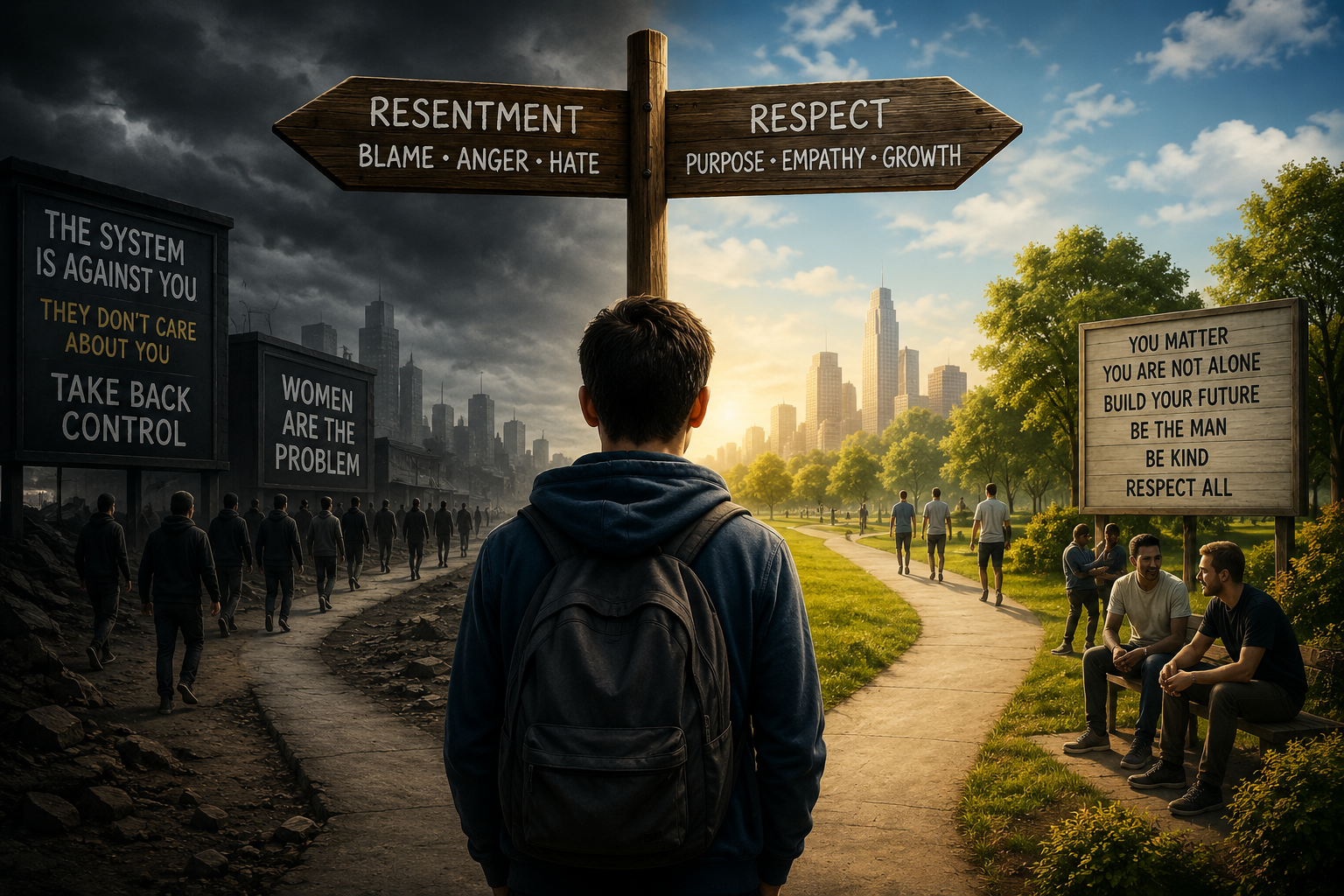
There is a growing phenomenon in modern society that many people find troubling, and rightly so. Across social media platforms, increasingly influential voices are telling young men that society no longer values them, that feminism has come at their expense, and that women are somehow to blame for their frustrations, loneliness and uncertainty.
Some of these voices present themselves as champions of masculinity, confidence and self-improvement. They speak about discipline, self-respect, physical fitness, ambition and resilience. To many young men—particularly those struggling with identity, rejection, isolation or lack of direction—that message can initially sound appealing, even helpful.
But too often the message does not stop there. What begins as encouragement can gradually become grievance. Frustration becomes resentment. Women become the problem. Compassion becomes weakness. Dominance is confused with strength. Empathy is replaced with anger. Misogyny becomes disguised as “truth telling.” That should concern all of us.
As the father of three daughters, I spent much of my life teaching them that there is nothing a man can do that they cannot. I continue to believe deeply in the importance of equality, dignity and opportunity for women. I have also served as Chair of the Saskatoon Sexual Assault Centre and have seen firsthand the devastating consequences that can arise when women are devalued, objectified or treated without respect.
There is no question that women have historically faced systemic barriers and inequality. There remains important work to do. Feminists and advocates have played, and continue to play, a vital role in challenging those inequalities and pushing society toward fairness and accountability.
At the same time, we should not ignore a reality that is increasingly apparent: many young men feel uncertain about where they fit in modern society. Some feel they are falling behind educationally, socially and emotionally. Some struggle to form relationships. Some lack positive role models. Some are lonely. Some are angry. Some simply feel invisible. If we dismiss those feelings outright, others will step into that vacuum.
Unfortunately, some influencers have become very skilled at identifying these vulnerabilities and exploiting them. They offer simplistic explanations for complex problems. They offer belonging, certainty and identity. They tell young men that their frustrations are someone else’s fault. They encourage them to harden themselves emotionally rather than mature emotionally. That is dangerous.
However, I do not believe the answer is simply to ridicule or condemn every young man who is drawn toward these movements. Doing so often reinforces the very alienation that made the messaging attractive in the first place.Instead, we should ask difficult but necessary questions. Why are some young men so susceptible to these messages? What legitimate emotional or social needs are not being met? Why are so many searching online for meaning, mentorship and identity? Why are some finding more validation from social media personalities than from families, schools, communities or society itself? Those questions matter.
The overwhelming majority of young men are not misogynists. Most want purpose, respect, connection and meaning. Most want healthy relationships. Most want to feel valued. The challenge is ensuring they are guided toward maturity, empathy, responsibility and confidence without teaching them resentment, entitlement or hostility toward women.
We need better conversations about masculinity—not fewer. Young men need role models who can teach strength without cruelty, confidence without arrogance, discipline without domination, and resilience without emotional detachment. We should be capable of supporting equality for women while also acknowledging that young men face struggles of their own. Those ideas are not mutually exclusive. In fact, a healthy society requires both.
What concerns me most is not simply the existence of these online movements, but the possibility that we are failing to offer enough positive alternatives before young men encounter them. If a young man is searching online for guidance about confidence, masculinity, relationships, discipline or purpose, who is waiting for him there? Increasingly, the loudest voices are often the most divisive ones.
We should not leave the development of young men to social media algorithms. Families, schools, coaches, mentors and communities all have a role to play. Boys and young men need encouragement, accountability, emotional intelligence, healthy role models and a sense of purpose. They need to understand that masculinity does not require domination, emotional suppression or hostility toward women.
Strength and empathy are not opposites. A confident man should not feel threatened by equality. A strong man should not need to diminish others in order to feel valuable himself. Respect, discipline, responsibility and kindness are not signs of weakness. In many respects, they are the clearest signs of maturity.
We should also be willing to have honest conversations with young men about rejection, loneliness, insecurity and identity without mocking or dismissing them. If society refuses to acknowledge those struggles, others will exploit them. The answer is not to move backward on equality, nor to pit men and women against one another in a competition for grievance or victimhood. The answer is to build a healthier understanding of relationships, responsibility and mutual respect.
Most young men are not looking for hatred. They are looking for direction. We should make sure the people providing that direction are leading them somewhere better.
There is also a broader societal question we cannot ignore: what responsibility do governments, educational institutions and technology platforms have in addressing this growing problem? Education is largely a provincial responsibility, and perhaps it is time to consider whether our schools are adequately preparing young people—not just academically, but socially and emotionally—for the realities of modern relationships, online influence and identity formation.
Young people today are growing up in an environment fundamentally different from anything previous generations experienced. Social media algorithms actively push emotionally charged and polarizing content because outrage and grievance generate engagement. A vulnerable teenager searching online for confidence, masculinity or self-worth can quickly find himself immersed in content that gradually normalizes resentment, manipulation and hostility toward women. That should concern us.
Perhaps there is room within secondary and post-secondary education for more meaningful discussion around healthy relationships, emotional intelligence, respectful masculinity, online radicalization, media literacy and critical thinking. Perhaps counsellors and student support services should receive additional training in identifying and addressing unhealthy online influence before it hardens into anger or alienation.
At the same time, governments and regulators may eventually need to confront difficult questions about the responsibility of large technology platforms whose algorithms increasingly profit from outrage, division and vulnerability. Freedom of expression remains critically important in a democratic society, but so too is the recognition that digital systems can amplify harmful messaging at a scale previously unimaginable.
None of these issues lend themselves to simple solutions. Nor should every controversial opinion be treated as dangerous. But neither should we ignore the reality that some online personalities are building influence and wealth by exploiting insecurity, loneliness and resentment among young men. If we genuinely care about the next generation, we should be investing at least as much energy into helping young men develop empathy, maturity, confidence and purpose as we do into condemning the harmful voices competing for their attention.